
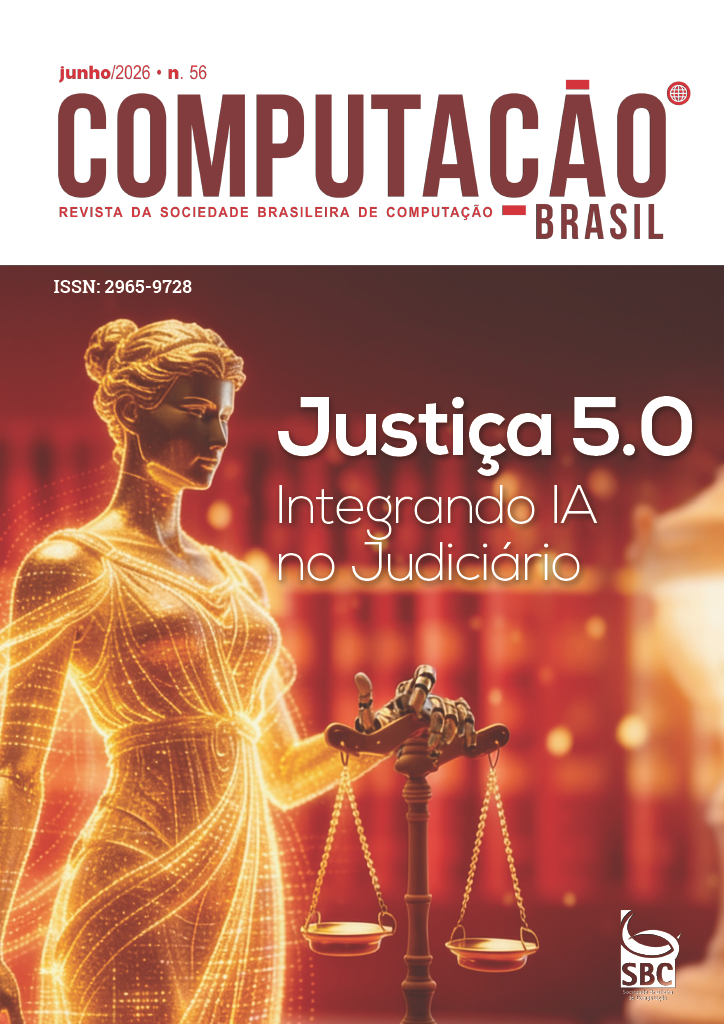
Inteligência Artificial e Ecossistema Jurídico: iniciativas em benefício da Sociedade
DOI:
https://doi.org/10.5753/compbr.2026.56.8607Keywords:
IA Legal, Processamento de Linguagem NaturalAbstract
Este trabalho examina o uso da Inteligência Artificial (IA) na transformação do ecossistema jurídico brasileiro, diante do elevado volume de processos e das limitações operacionais do Poder Judiciário. Apresentamos um panorama de iniciativas provenientes tanto da academia quanto do próprio Judiciário, voltadas à redução do tempo de execução das tarefas e à desoneração das equipes responsáveis pela análise manual.
Downloads
Referências
Albuquerque et al. (2022). UlyssesNER-Br: A Corpus of Brazilian Legislative Documents for Named Entity Recognition. Proceedings of the 14th International Conference on Computational Processing of Portuguese (PROPOR 2022).
Alles, V. (2018). Construção de um corpus para extrair entidades nomeadas do diário oficial da união utilizando aprendizado supervisionado. Master’s thesis UNB.
Almeida, P. G. R. (2021). Uma jornada para um Parlamento inteligente: Câmara dos Deputados do Brasil. Red Información, 24.
Brito et al. (2023). CDJUR-BR - Uma Coleção Dourada do Judiciário Brasileiro com Entidades Nomeadas Refinadas. In Anais do XIV Simpósio Brasileiro de Tecnologia da Informação e da Linguagem Humana.
Castro, P. (2018). Deep learning for named entity recognition in legal domain. Master’s thesis, Universidade Federal de Goiás.
Chalkidis, I., Androutsopoulos, I., and Aletras, N. (2019). Neural Legal Judgment Prediction in English. In Proceedings of the 57th Annual Meeting of the Association for Computational Linguistics.
Chalkidis et al.(2021). Regulatory Compliance through Doc2Doc Information Retrieval: A case study in EU/UK legislation where text similarity has limitations. In Proceedings of the 16th Conference of the European Chapter of the Association for Computational Linguistics.
Justiça em números 2025. [link]. Último acesso: 12/01/2026.
Costa et al. (2022). Expanding UlyssesNER-Br Named Entity Recognition Corpus with Informal User-Generated Text. In Proceedings of the 21st EPIA Conference on Artificial Intelligence (EPIA 2022).
Garcia et al. (2024). RoBERTaLexPT: A Legal RoBERTa Model pretrained with deduplication for Portuguese. In Proceedings of the 16th International Conference on Computational Processing of Portuguese (PROPOR 2024).
Hartmann Peixoto, F. (2020). Projeto Victor: relato do desenvolvimento da Inteligência Artificial na Repercussão Geral do Supremo Tribunal Federal. Revista Brasileira de Inteligência Artificial e Direito - RBIAD, 1(1):1–22.
Kapoor et al. (2022). HLDC: Hindi legal documents corpus. In Findings of the Association for Computational Linguistics: ACL 2022.
Kornilova, A. and Eidelman, V. (2019). BillSum: A Corpus for Automatic Summarization of US Legislation. In Proceedings of the 2nd Workshop on New Frontiers in Summarization.
Luz de Araujo et al. (2018). LeNER-Br: A Dataset for Named Entity Recognition in Brazilian Legal Text. In 13th Computational Processing of the Portuguese Language (PROPOR 2018).
Maia et al. (2022). UlyssesSD-Br: Stance Detection in Brazilian Political Polls. Proceedings of the 21st EPIA Conference on Artificial Intelligence (EPIA 2022).
Malik et al. (2021). ILDC for CJPE: Indian legal documents corpus for court judgment prediction and explanation. In Proceedings of the 59th Annual Meeting of the Association for Computational Linguistics , pages 4046–4062. Association for Computational Linguistics.
Maxwell, K. T. and Schafer, B. (2008). Concept and context in legal information retrieval. In Legal Knowledge and Information Systems, pages 63–72. IOS Press.
Silva et al. (2021). Evaluating topic models in portuguese political comments about bills from brazil’s chamber of deputies. In Britto, A. and Valdivia Delgado, K., editors, Intelligent Systems, pages 104–120, Cham. Springer International Publishing.
Siqueira et al. (2024). Ulysses tesemõ: a new large corpus for brazilian legal and governmental domain. Language Resources and Evaluation, pages 1–20.
Souza et al. (2021). An information retrieval pipeline for legislative documents from the brazilian chamber of deputies. In Legal Knowledge and Information Systems, pages 119–126. IOS Press.
Souza et al. (2023). Building a relevance feedback corpus for legal information retrieval in the real-case scenario of the brazilian chamber of deputies.
Downloads
Published
Como Citar
Issue
Section
Licença

Este trabalho está licenciado sob uma licença Creative Commons Attribution-NonCommercial 4.0 International License.
