
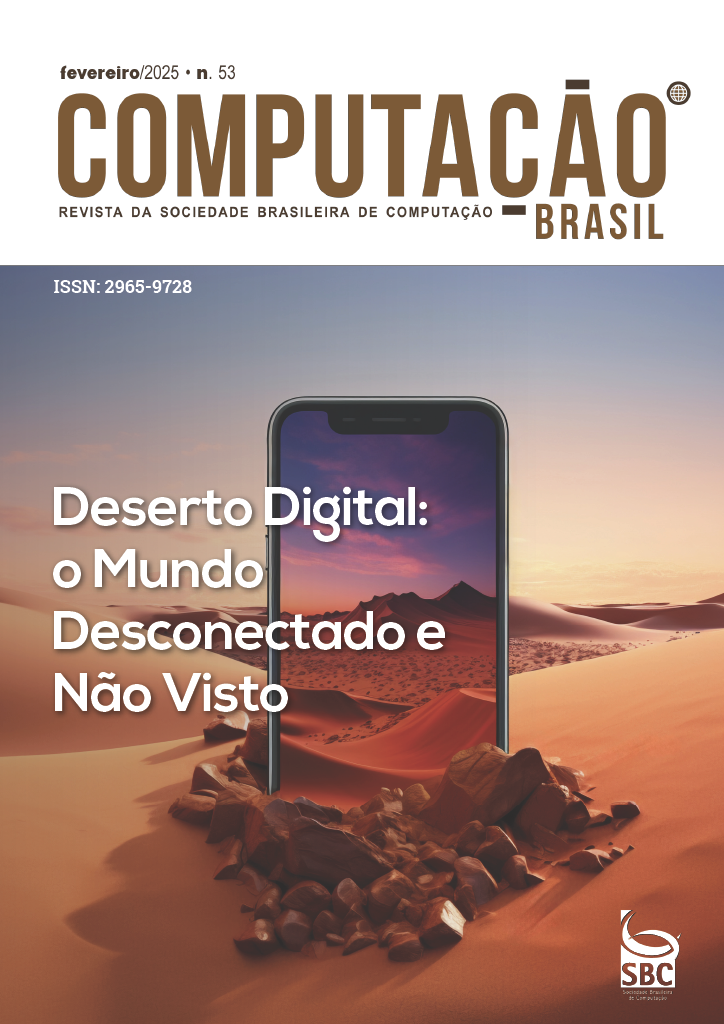
Disconnected and Invisible World: Research Challenges and Opportunities to Mitigate Digital Inequality
DOI:
https://doi.org/10.5753/compbr.2025.53.5586Keywords:
Digital divide, Meaningful connectivityAbstract
Did you know that one-third of the world's population remained offline in 2023? Or that, during the pandemic, two-thirds of school-age children worldwide did not have access to the internet? Although superlative and worrying, these numbers unfortunately reveal very little about the existence of a truly "disconnected and invisible world". Socioeconomic, cultural, and educational disparities, among others, also affect a significant portion of the world's population who, despite having access to digital technologies and the internet, face great difficulties in their daily digital lives. In this report, we discuss some of the reasons for the existence of this disconnected and invisible world, and list challenges and opportunities for research in Computing to mitigate digital exclusion and inequality and promote digital inclusion in regions in need.
Downloads
References
BENTLEY, Sarah V. et al. The digital divide in action: how experiences of digital technology shape future relationships with artificial intelligence. AI and Ethics, p. 1-15, 2024.
BOŽIĆ, Velibor. Artificial intelligence as the reason and the solution of digital divide. Language Education and Technology, v. 3, n. 2, 2023.
CALDEIRA, Clara; NURAIN, Novia; CONNELLY, Kay. “I hope I never need one”: Unpacking Stigma in Aging in Place Technology. In: Proceedings of the 2022 CHI Conference on Human Factors in Computing Systems. 2022. p. 1-12.
FARAHANI, Milad; GHASEMI, Ghazal. Artificial intelligence and inequality: Challenges and opportunities. International Journal on Innovative Education, v. 9, p. 78-99, 2024.
HOLGERSSON, Jesper; KÄVRESTAD, Joakim; NOHLBERG, Marcus. Cybersecurity and Digital Exclusion of Seniors: What Do They Fear?. In: International Symposium on Human Aspects of Information Security and Assurance. Cham: Springer International Publishing, 2021. p. 12-21.
LYTHREATIS, Sophie; SINGH, Sanjay Kumar; EL-KASSAR, Abdul-Nasser. The digital divide: A review and future research agenda. Technological Forecasting and Social Change, v. 175, p. 121359, 2022.
MYRDAL, Gunnar. Teoria econômica das regiões. Saga, 1968. Disponível em: [link]. Acesso em: Dezembro, 2024.
CONECTIVIDADE SIGNIFICATIVA: propostas para medição e o retrato da população no Brasil. Comitê Gestor da Internet no Brasil–CGI.br São Paulo 2024. Disponível em: [link]. Acesso em: Dezembro, 2024.
PAIVA, Débora Maria Barroso; FREIRE, André Pimenta; DE MATTOS FORTES, Renata Pontin. Accessibility and software engineering processes: A systematic literature review. Journal of Systems and Software, v. 171, p. 110819, 2021.
SIN, Jaisie et al. Digital design marginalization: New perspectives on designing inclusive interfaces. In: Proceedings of the 2021 CHI Conference on Human Factors in Computing Systems. 2021. p. 1-11.
UNITED NATIONS. Promotion and protection of all human rights, civil, political, economic, social and cultural rights, including the right to development. United Nations: General Assembly. UN Digital Library, A/HRC/17/27, 2011.
VAN DIJK, J. A. G. M. Digital divide: Impact of access. The international encyclopedia of media effects, v. 1, p. 1-11, 2017.
Downloads
Published
How to Cite
Issue
Section
License

This work is licensed under a Creative Commons Attribution-NonCommercial 4.0 International License.
