Mundo Desconectado e Invisível: Desafios e Oportunidades de Pesquisa para Mitigar a Desigualdade Digital
DOI:
https://doi.org/10.5753/compbr.2025.53.5586Keywords:
Exclusão digital, Conectividade significativaAbstract
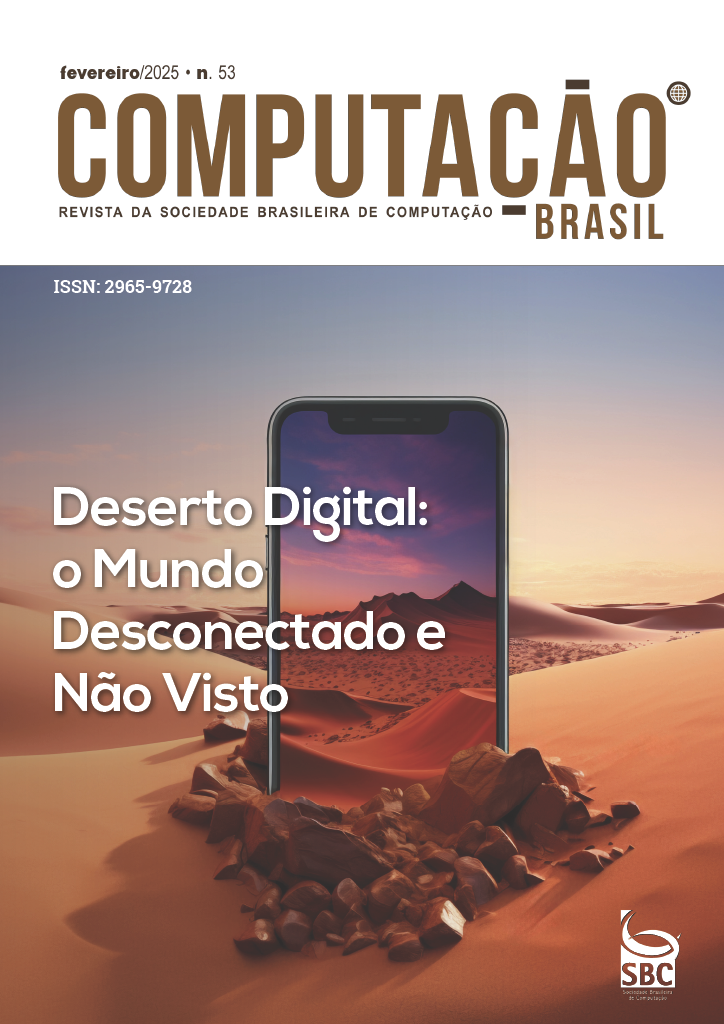
Você sabia que um terço da população mundial continuou desconectada em 2023? Ou que, durante a pandemia, dois terços das crianças em idade escolar no mundo não tinham acesso à internet? Embora superlativos e preocupantes, esses números infelizmente revelam muito pouco sobre a existência de um verdadeiro "mundo desconectado e invisível". Disparidades socioeconômicas, culturais e educacionais, entre outras, também afetam uma parcela significativa da população mundial que, embora tenha acesso a tecnologias digitais e à internet, enfrentam grandes dificuldades no dia a dia digital. Neste artigo, discutimos alguns dos motivos para a existência deste mundo desconectado e invisível, e elencamos desafios e oportunidades de pesquisa em Computação para mitigar a exclusão e desigualdade digital, e promover a inclusão digital em regiões necessitadas.
Downloads
Referências
BENTLEY, Sarah V. et al. The digital divide in action: how experiences of digital technology shape future relationships with artificial intelligence. AI and Ethics, p. 1-15, 2024.
BOŽIĆ, Velibor. Artificial intelligence as the reason and the solution of digital divide. Language Education and Technology, v. 3, n. 2, 2023.
CALDEIRA, Clara; NURAIN, Novia; CONNELLY, Kay. “I hope I never need one”: Unpacking Stigma in Aging in Place Technology. In: Proceedings of the 2022 CHI Conference on Human Factors in Computing Systems. 2022. p. 1-12.
FARAHANI, Milad; GHASEMI, Ghazal. Artificial intelligence and inequality: Challenges and opportunities. International Journal on Innovative Education, v. 9, p. 78-99, 2024.
HOLGERSSON, Jesper; KÄVRESTAD, Joakim; NOHLBERG, Marcus. Cybersecurity and Digital Exclusion of Seniors: What Do They Fear?. In: International Symposium on Human Aspects of Information Security and Assurance. Cham: Springer International Publishing, 2021. p. 12-21.
LYTHREATIS, Sophie; SINGH, Sanjay Kumar; EL-KASSAR, Abdul-Nasser. The digital divide: A review and future research agenda. Technological Forecasting and Social Change, v. 175, p. 121359, 2022.
MYRDAL, Gunnar. Teoria econômica das regiões. Saga, 1968. Disponível em: [link]. Acesso em: Dezembro, 2024.
CONECTIVIDADE SIGNIFICATIVA: propostas para medição e o retrato da população no Brasil. Comitê Gestor da Internet no Brasil–CGI.br São Paulo 2024. Disponível em: [link]. Acesso em: Dezembro, 2024.
PAIVA, Débora Maria Barroso; FREIRE, André Pimenta; DE MATTOS FORTES, Renata Pontin. Accessibility and software engineering processes: A systematic literature review. Journal of Systems and Software, v. 171, p. 110819, 2021.
SIN, Jaisie et al. Digital design marginalization: New perspectives on designing inclusive interfaces. In: Proceedings of the 2021 CHI Conference on Human Factors in Computing Systems. 2021. p. 1-11.
UNITED NATIONS. Promotion and protection of all human rights, civil, political, economic, social and cultural rights, including the right to development. United Nations: General Assembly. UN Digital Library, A/HRC/17/27, 2011.
VAN DIJK, J. A. G. M. Digital divide: Impact of access. The international encyclopedia of media effects, v. 1, p. 1-11, 2017.
Downloads
Published
Como Citar
Issue
Section
Licença

Este trabalho está licenciado sob uma licença Creative Commons Attribution-NonCommercial 4.0 International License.